
Ask the Ref: how many infringements are needed for 'repeated infringements'?
Is there something in the game, or something within the Laws of Rugby that you’re maybe not 100% clear about? Rob McKay is here to help

In the latest edition of Ask the Ref, experienced NSW Referee Rob McKay is here to answer all your questions with clear, simple explanations. In true ‘referee speak’, if you like.
This is an opportunity to engage in discussion about the Laws, and to take away some of the mysticism about the way the game if being officiated. And yes, we’d love for you to submit your questions for future editions! We’re keeping track of questions asked!
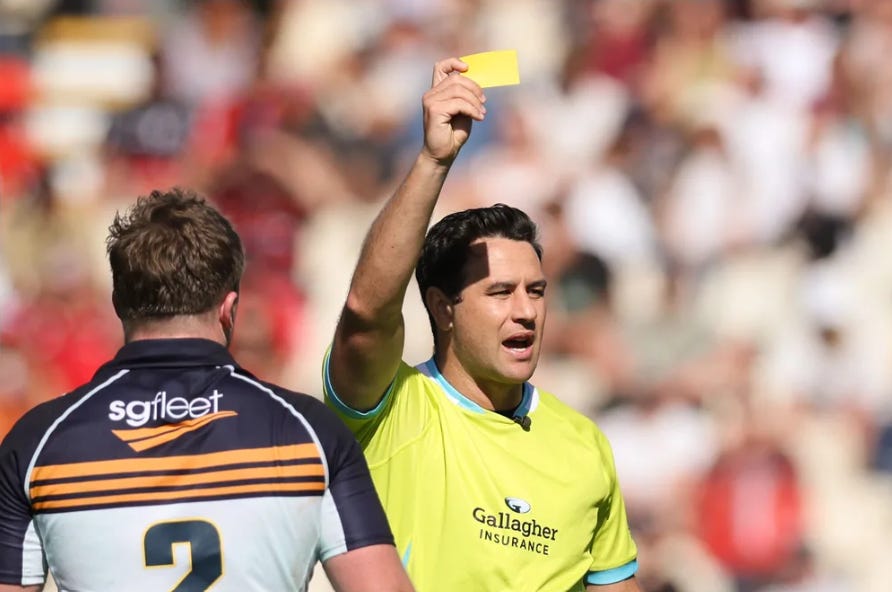
Q1. What is the general consensus around repeated infringements?
How many penalties (or advantages) warrant a warning, and how many would be needed to just go straight to the yellow card?
The best place to start is the framework.
“Repeated Infringements” is a heading under Law 9 - Foul Play, a fact known by too few, but which helps illuminate why the sanction process is what it is.
The Definition section provides further insight, noting it applies to “Anything a player does within the playing enclosure...” The “Playing enclosure” is also found in the Definition section: “The playing area plus a space around it, which is known as the perimeter area.”
It is further illustrated in Law 1. It is important to understand the geographical scope of the match officials’ remit.
The opening line of Law 9, under the heading Principle, reads: “A player who commits foul play must either be cautioned or shown a yellow card or sent off.” An excellent starting point.
Then we dig deeper into Law 9. Under the heading “Repeated Infringements”, we have sections 8, 9 and 10, as follows:
8. A team must not repeatedly commit the same offence.
9. A player must not repeatedly infringe the laws. Sanction: Penalty.
10. When different players of the same team repeatedly commit the same offence, the referee gives a general caution to the team and if they then repeat the offence, shows a yellow card to the guilty player(s).
Brought together, the above represents the formal framework for decision-making. The black letter law is clear and straightforward. For the sake of the argument, let’s call this the science component.
Next, we move onto the ‘art’ element, which is knowing when and how to apply it in a match environment, taking into account all the subtle, and sometimes not so subtle, nuances that each match provides. And the secret sauce: managing the game as best as possible to prevent it.
So, the starting point? Recognising trends or patterns of behaviour. Slowing down the ball at the breakdown, infringing in the red zone, scrum penalties, high tackles - they are all examples of common patterns that may trigger penalties. And I say ‘may’, because they could also lead to advantages, from which the non-offending team do well enough to play away from, but that doesn’t mean the trend disappears.
The most difficult trend to recognise is the ‘no trend’ trend. A series of random sanctions across the park - no real pattern, except that in itself is the pattern - a high penalty count. It could be a result of poor discipline, poor technique, low level of law knowledge, or it could be the complete opposite - that is how the team plays, with a desperation to do anything necessary to prevent the opposition from scoring.
So, what should the referee do? Go to the referee toolkit! Ideally, we want to keep everyone on the field, but that is up to the players to decide by their behaviour. So, having recognised the trend, it’s time to transfer the pressure onto the players, and the best way to do that is with an informal chat with the captain.
And this is where ensuring you have a good captain is crucial to a team’s success (but that’s a whole new chat for another day). And so starts the escalation process.
Every referee will do this differently, but it goes something like this:
“Hey, Skip, the last two times we’ve been in the red zone, you’ve given away an offside penalty, and we’re entering the red zone again”. A good captain will take that message back to the players, and a good team will then decide on its response. It may be to take a step, or it may be to run the risk. Or it may not be that conscious at all, depending on the level and capability.
If a similar penalty re-occurs, this is when the double blow of the whistle occurs, time off is signalled (even if time off isn’t played in the match - it’s all part of the theatre, as much for the crowd as the players), and the captain is called over.
A quick chat, something like this: “Hey, Skip, we just had a chat about this, and we’ve had another offside in the red zone. That’s three now - if it happens again, I’ll be putting a player in the bin”. Again, pressure is transferred to the captain and the playing group, and what happens next is up to them. If they repeat the same offence, it’s an easy yellow card - everyone has seen the process, the communication has been clear, and often the player starts heading off the field before the card is even shown!
That’s a textbook example. The shades of grey are where it can be confusing.
For example, multiple advantages in a series of phases in the red zone may be enough to trigger a YC without the formal warning - three or four advantages in such a situation would be justifiable grounds. A smart team should have the nous to recognise that on the run, but again, that may also be a strategy to transfer pressure to the referee. And there are teams known for that...
Yellow cards can also be issued without warning in various scenarios.
The most common are often referred to as ‘cynical’ or ‘deliberate’ offences, which are more accurately described under the Unfair Play heading of Law 9, using ‘intentionally’ as the descriptor.
An isolated defender in the red zone not releasing the ball, or a similar breakdown offence slowing the ball down in that part of the field, is an obvious example.
The decision making process for an intentional knock forward is another one, depending on whether there was a line break opportunity (YC) or a probable try (YC + penalty try).
Interestingly, one of the SRP Law variations this year gives the match officials the option not to trigger a YC in certain penalty try circumstances where the offending player’s action doesn’t otherwise ‘meet the threshold’ (e.g., repeated infringements, head contact, etc).
The extra layer, of course, is game context and the connection between the match officials and the game.
For example, does a team getting flogged really need a YC for multiple offsides when those offsides are causing gaps in their defensive line, which the better team is happily exploiting?
Probably not... Conversely, does a team that is obviously infringing and takes no heed of warnings need a full escalation process? Quite possibly not, as it may be seen as intentional.
And that is where the intersection of art and science comes together, and what separates the many good referees from the great ones: knowing when to pull the trigger and when to let it breathe.
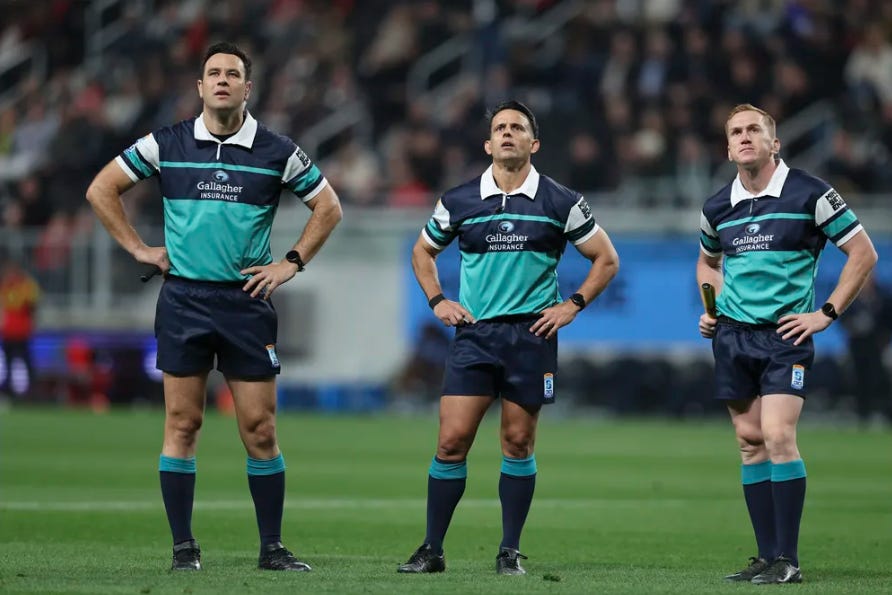
Q2. What are the biggest changes or trends in the game currently that have impacted refereeing, and what is something that could be changed that would make life easier for refs?
The only constant is change. The game evolves, as does the officiating and while the core principles remain strong and largely unchanged, many other variables are in play.
Recent factors that feature in this discussion include differences in officiating at the elite level compared with the community level.
The archetype of this is when, at a community game, the crowd shouts at the assistant referee, expecting them to call everything the referee has missed, magically. Possibly by smoke signal.
Because the AR with the flag, even if an accredited referee, isn’t telepathic, and rarely has communications gear. Despite what the crowd thinks. Too little understanding of the differences, and therefore, higher expectations due to the good work done by the pros.
The pace of the game has no doubt increased. A 1960s Five Nations match featured 111 lineouts. That is NOT a typo.
A Shute Shield match can see a referee run eight kilometres, all while making several thousand decisions and non-decisions under load. A suburban 1st Grade match will be between five and six kilometres, and while the pace slows down through the lower grades, the trend is toward more movement in a shorter space of time. Think of it as a HIIT session while overseeing a hit session.
The safety frameworks are now more thorough and transparent. Head contact, foul play, and most noticeably, around concussion, whether the blue card used in community, or the HIA process at the elite level. The lens through which match officials view the game has changed, with an increased focus on player welfare. This is something that benefits everyone.
The growth of female participation adds another dimension, and a positive one at that. But it also requires consideration, empathy and adjustment. Some struggle with it, others embrace it. I love this growth and thoroughly enjoy my engagement with our female cohort - the more, the merrier!
But Utopia would be where every player and spectator has to sit a meaningful law exam. It’s a dream, of course, but a more informed rugby community leads to better discourse, understanding and empathy for all involved, and would materially improve the retention of match officials.
Abuse, often driven by ignorance, is usually the single biggest reason we lose match officials. That says it all.
Q3. What’s the best sledge you have heard from the punters at games? (Aimed at you or not)
What a Pandora’s box we’ve opened here! Where selective deafness and post-match speech content conflict to create natural tension.
What is abuse that should not be tolerated and therefore reported? What if I find it funny, but my successor next week does not? What is friendly banter, and what is derogatory? Some of it is black and white, but there is also a LOT of grey.
The punters think they’re pretty good, and I have been known to include myself in that category over the years. But consistently the best chirp is always on the field, and most often it’s at scrum time.
The funniest dialogue occurred a few years ago at a match in Sydney’s east, featuring the holders of the Bingham Cup against another team. It’s a story I can’t repeat here, but it’s fair to say it took several minutes before we could pack the scrum once everyone had stopped laughing at least on one side, as the chirp was all internal.
The other team, mainly students, stood there with eyes like dinner plates.
Scrum chat often features forwards sledging backs, often their own. Occasionally, if rapport building is required, I may also make a contribution... but it’s a slippery slope and needs to be done with care, as it can be a trap, especially for new players. Know your audience. But talking about pies is always welcome when discussing important details with the front row.
Four’N’Twenty – proud sponsors of NSW referees - are definitely onto a good thing.
A more recent story, which can be repeated, occurred in a premiership game. The locals were struggling to calibrate the scoreboard, and just as we were setting the scrum, the score showed 999-0 in favour of the home side. At that moment, the home 8 popped his head up, quipped “tough day”, which was timed just so that 16 forwards could somehow cast a sideways glance, see the score, and lose it, on both sides. Shots fired, but received in good spirits, and another scrum reset was required.
But my all-time favourite features South Africa’s Craig Joubert, and this is a story I’ve heard him recount in person.
Craig has done it all - refereed a World Cup final, Super Rugby finals, Sevens, and is now a World Rugby referee development coach.
But once upon a time, he was a rookie, at least in the Super Rugby ranks. And in one of his first matches, he found himself in Canberra, on one of those cold winter nights that Canberra does so well, and he came across a Brumbies team in their pomp, with George Gregan running the show.
And he really was. Along with his teammates. So much so that Craig, despite being as green as he was, recognised that the game was getting away from him, so he took GG aside and had a word with him.
“George - we can’t have this - there are fifteen referees out here, it’s not working”.
To which GG immediately replied: “Yeah, and you’re not even in the Top 10!”.
GG 1, CJ 0!
Update - hands in the ruck
So far this year, World Rugby has issued two Law Clarifications and one Law Application Guideline. More details about them another time.
But the second of the former, issued on June 1, deals with scrum halves moving the ball in a ruck with their hands, an eerily familiar topic, unless of course, you’re a regular reader of this column, in which case you already knew the answer.
8/9 Rugby - ahead of its time.
Do you have a question about the Laws, or the way the game is being officiated for Rob to tackle in the next edition of Ask the Ref? Drop your question into the comments below, and we’ll try and get to them in the coming weeks and months.
🎧 Catch Rob on Play On: The Rugby Referee podcast, where he’s joined every week by Candace Barritt and former Super Rugby ref Nathan Pearce. Get it on Spotify and pod platforms everywhere!
 | A guest post by
|
Thanks so much once again Rob, this is a great explanation of something we see in every game, but often appears different each time we see it, so good to at least know how the framework and thinking behind advantage works..
Thanks Rob. Very interesting reading.
Story from way back involving Irish prop Phil O'Callaghan. The referee blows his whistle and says sternly "O'Callaghan, your'e boring ! To which Phil replies " Sir, I don't find you a very interesting personality either"